

Joji Ilagan International Schools Strengthens Philippine-Led Research Collaboration on AI-Powered Tourism
INTERNATIONAL RESEARCH | PARTNER NEWS

Philippine research lead Dr Nicole Hao Bian Ledesma joins Indonesian and Vietnamese partners in a study recognised at ISSAT 2026.
DAVAO CITY, PHILIPPINES / BANDUNG, INDONESIA | November 2026
Joji Ilagan International Schools (JIIS), Philippines, is participating in an international research collaboration with Politeknik Negeri Bandung (Polban), Indonesia, and Duy Tan University, Vietnam, to investigate how generative artificial intelligence (GenAI) and online travel agencies (OTAs) support tourists as they move from travel inspiration towards informed decisions. Dr Nicole Hao Bian Ledesma serves as Head of Research for the Philippine component of the collaboration, contributing to its cross-country perspective and academic coordination.
The project, “From Intention to Decision: Comparing
Generative AI and OTAs in Cross-Border Trip Planning across Indonesia, the
Philippines and Vietnam”, is led by Dr Tomy Andrianto of Polban under its 2026
International Research Partnership scheme. Research partners from the three
countries are examining the roles of information quality, personalisation,
trust, perceived control and decision confidence in international trip
planning.
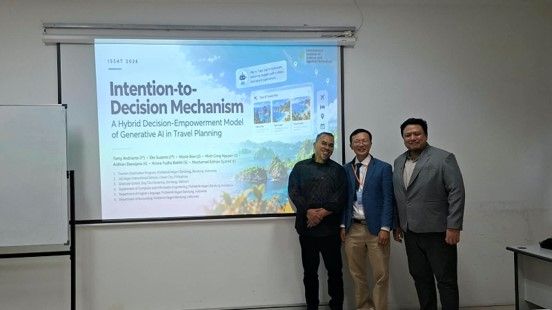
Research presentation on the Hybrid Decision-Empowerment Model during ISSAT 2026 at Politeknik Negeri Bandung, Indonesia.
The Philippine contribution to a regional research agenda
The participation of Joji Ilagan International Schools adds
a Philippine perspective to the research, helping the team consider how
different travel experiences and digital habits may shape travellers’ responses
to emerging technologies. Dr Ledesma’s role as Philippine research lead
supports local research coordination and the wider exchange of ideas with
colleagues in Indonesia and Vietnam. The collaboration is designed to encourage
international comparative research rather than assume that findings from one
country apply uniformly across Southeast Asia.
The study uses a Hybrid Decision-Empowerment Model (HDEM) and combines quantitative investigation with qualitative exploration. A travel-planning task involving a five-day, four-night Shanghai–Hangzhou itinerary provides a common research context for examining how people consult GenAI alongside travel-booking and verification platforms. In a separate Indonesian qualitative component involving 21 participants, researchers observed a complementary pattern: GenAI was valuable for exploration and itinerary development, while OTAs and other sources helped verify operational details, such as availability, transport and prices. These qualitative insights should not be interpreted as completed statistical comparisons across all three countries.
Best Presenter Award at ISSAT 2026
An associated paper, “Intention-to-Decision Mechanism: A Hybrid Decision-Empowerment Model of Generative AI in Travel Planning”, was presented at the 5th International Seminar of Science and Applied Technology (ISSAT 2026), held at Polban on 14 October 2026. The presentation received a Best Presenter Award, recognising the dissemination of the team’s work at the international conference. The conference paper has also been accepted for the ISSAT proceedings.
A related qualitative manuscript, “From Exploration to Verification: How Indonesian Travelers Combine Generative AI and Online Travel Agencies in Planning Trips to China”, is currently under peer review at the Journal of China Tourism Research. This status indicates that the journal’s editorial and review process is ongoing, rather than that the article has been accepted for publication.
Expanding towards tourism technologies and halal tourism
The research partnership is intended to continue beyond the current project. Future work will explore more industry-relevant questions in tourism technologies and halal tourism, including trustworthy digital travel information, service design and traveller needs. The partners also envisage engaging a more diverse network of universities to bring additional academic specialisations and travel-market perspectives into collaborative studies.
For Joji Ilagan International Schools, participation provides an avenue to strengthen international research engagement, joint dissemination and exchanges with regional academic partners. The long-term goal is to generate evidence that can inform tourism education, digital travel services and more inclusive visitor experiences.

Participants and researchers at ISSAT 2026, an international forum for presenting applied technology research.
